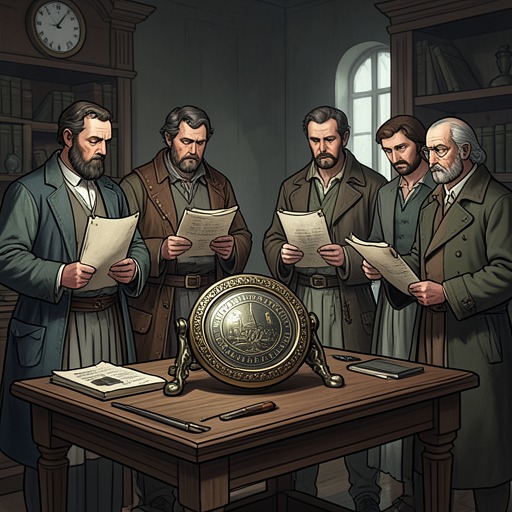
Sun Jian's Discovery of the Imperial Seal
The Romance of the Three KingdomsSun Jian's Discovery of the Imperial Seal begins amid the destruction of Luoyang and ends with the relic carried away in secret. A recovery amid the wreckage of the Han capital becomes a political rupture: the seal is treated not merely as a precious imperial object but as a sign of authority, and Sun Jian’s concealed departure helps break apart the coalition that had united against Dong Zhuo.
The Ruined Capital and the Discovery
After Dong Zhuo’s flight, Sun Jian arrives in devastated Luoyang and orders the fires extinguished, the palaces cleared, and the imperial tombs sealed. He also has offerings made to the ancestors. When the ceremony is finished, he looks at the night sky and sees a pale mist obscure one constellation. Reading this as an omen that the imperial star has lost its brightness, he mourns the dynasty and the capital, then falls to his knees and weeps.
The scene shifts from public ruin to a hidden object. While Sun Jian sits in melancholy, a soldier points out five strange lights coming from a well. Sun Jian orders an investigation. The soldiers find the intact body of a woman, with an embroidered pouch around her neck; inside the pouch is a small, beautiful box with a golden clasp. The box contains a jade seal carved at its top with five entwined dragons. One corner is broken and repaired with gold, while eight characters in ancient seal script are carved into its base: “Receive the Mandate of Heaven: now you will have long life and eternal prosperity.” The unusual lights, the recovered courtly object, and its inscription make the discovery seem charged with more than material value.
The Seal’s History and Its Meaning
Sun Jian shows the seal to his adviser Cheng Pu, who recognizes it as the emperors’ seal and recounts its history. His account reaches back to a piece of jade discovered after a phoenix appeared on a stone on Jian Mountain. The jade was cut by order of the first emperor, and Li Si composed the seal’s eight characters. Cheng Pu recalls how the jade was cast into Lake Dongting during a storm to pacify the waves, then returned to the emperor by a mysterious old man years later.
The seal subsequently passed to the founder of the Han dynasty. During Wang Mang’s rebellion, the queen mother of the deposed emperor struck two rebels with it and chipped a corner; the damage was later repaired with gold. The emperor who restored the Han recovered the seal, which thereafter passed from emperor to emperor until it went missing during the troubles with the Ten Imperial Attendants. This history gives the object a material continuity across dynastic upheavals: the gold repair is not incidental decoration but a visible trace of an earlier crisis and recovery.
For Cheng Pu, the seal’s return is also a claim about the future. He tells Sun Jian that finding it must mean Sun Jian is destined to rule, and urges him to leave the north for their homeland in the southeast and begin preparing for kingship. The inscription’s promise of heavenly authorization thus acquires an immediate political interpreter. The account establishes what the object is within the story, but it also shows how its meaning can be turned into a prospect of personal sovereignty.
Concealment and the Coalition’s Fracture
Sun Jian readily agrees to Cheng Pu’s proposal. He plans to plead illness the following day and steal away with the seal. The departure is not an open claim to the throne: concealment is the means he chooses to protect the discovery and remove himself from scrutiny. But news of the seal escapes before he can carry out his plan unchallenged.
When Sun Jian comes to Yuan Shao and says that ill health requires him to return to Changsha, Yuan Shao declares that he knows the real illness: a bad case of the Imperial Seal. Yuan Shao tries to make him admit that he has found it, but Sun Jian refuses even to acknowledge the discovery. Deeply offended and frightened, he rides away with his entire army. The exchange leaves the claim unresolved in speech but decisive in action: Sun Jian departs, and Yuan Shao’s suspicions become a direct cause of the coalition’s weakening.
The consequences extend beyond the two men. Yuan Shao’s desire for the seal begins to pull the alliance apart, and Cao Cao also leaves, taking his troops to Yangzhou. Gongsun Zan, accompanied by the three brothers-in-arms, likewise concludes that Yuan Shao has no prospects. As they pass through Pingyuan, Gongsun Zan asks Xuande to remain there and defend it. A relic recovered in a ruined capital has therefore redirected armies and changed the coalition’s alignments before any settled verdict about Sun Jian’s possession of it is reached.
Narrative and Political Significance
The episode rests on a sharp contrast between the ritual repair of a damaged capital and the private appropriation of an object associated with imperial continuity. Sun Jian acts as a restorer when he orders the fires put out, the palaces cleared, and the tombs sealed; after the seal is found, however, he plans to conceal it and depart. The sequence places public mourning beside a private opportunity for power, without making the discovery itself settle whether that power is deserved.
The seal’s story also binds an older history of succession and upheaval to the present crisis. Its passage from the first emperor to the Han, its damage during Wang Mang’s rebellion, and its disappearance amid the palace troubles make it a compact record of repeated political disorder. Its reappearance at Luoyang arrives at a moment when the capital itself lies in ruins. In Cheng Pu’s reading, that return points toward Sun Jian’s future; in Yuan Shao’s response, it is a contested prize that threatens the alliance. The episode turns a recovered object into a test of how political authority is interpreted, claimed, and feared.